Understanding Argon Leak Detection and How the Right Tool Makes All the Difference

If you work around welding systems, specialty gas lines, or laboratory setups, you already know how sensitive argon can be. It slips through the smallest gaps and can cause real trouble if you are not watching for it. Before we get into the nuts and bolts, here is a fast way to dive deeper. The link here gives a solid overview: argon leak detector. Keep that in mind as we walk through how these detectors work, what makes them reliable, and how to pick one that fits your setup.
Why Argon Matters So Much
Here is the thing. Argon looks harmless, colorless, and quiet, but it can displace oxygen without warning. That matters in welding shops and labs where even a small leak can create unsafe pockets of low oxygen. Argon is heavier than air, so it settles into corners and around the floor. If you are relying on guesswork or a quick visual check, you will miss leaks every time. This is where an argon leak detector becomes the tool you wish you had from day one.
On top of the safety angle, argon is not cheap. If you use it for TIG welding, metal fabrication, or protecting sensitive equipment in controlled environments, wasted argon means wasted money. A tiny leak can burn through a cylinder faster than you think. That alone makes regular leak checks a smart habit.
Where Argon Leaks Usually Hide
Argon does not escape in dramatic bursts. It slips out quietly from spots you barely notice. These are the common hiding places:
- Loose or aging fittings around regulators and hoses
- Tiny pinholes along worn gas lines
- Valve seats that no longer seal tightly
- Pressure connections shaken loose by vibration
- Old Teflon tape that no longer grips threaded joints
- Micro cracks around welding torch components
None of these look serious on the surface. They add up though. If you have ever wondered why your tank empties faster on some days, you probably have one or more of these slow leaks.
How an Argon Leak Detector Works
What this really means is that your detector needs to pick up tiny changes in gas concentration with confidence. Argon itself is inert, and it does not react with much, so your detector must be sensitive rather than chemically reactive.
The best detectors use one of these sensor types:
- Thermal conductivity sensors
These work because different gases move heat differently. Argon has a very distinct thermal signature, so the detector notices when it is present in the air. - Ultrasonic sensors
These listen for the sound of pressurized gas escaping. Even if you cannot hear the noise with your ears, the sensor can pick up the hiss. - Mass spectrometry based tools
These are mostly used in advanced labs. They identify argon precisely by mass, but they cost more than most welding shops would ever need.
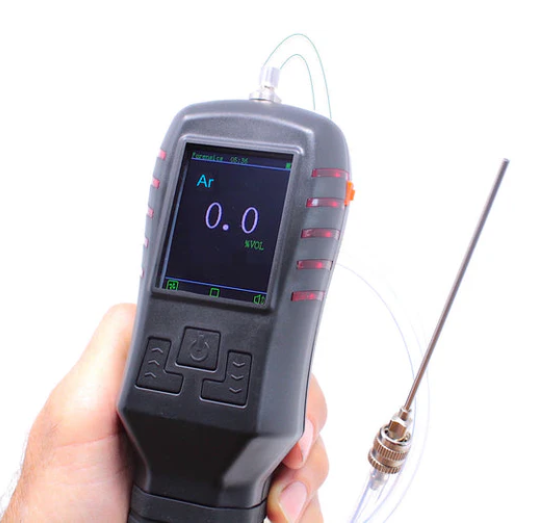
Whether you run a workshop or a research lab, a handheld argon leak detector often gives the best mix of accuracy, portability, and cost.
What Makes a Detector Worth Buying
Let’s break it down. If you want something that actually helps you catch leaks, watch for these features:
High sensitivity
Argon leaks can be incredibly subtle. You want a detector that can sense tiny concentrations without giving you a false alarm.
Adjustable alarm settings
When you are moving around cylinders, regulators, and manifold systems, being able to tune alarms to your environment helps a lot.
Fast warmup and response
You don’t want to stand around waiting for readings. A good detector reacts quickly and tracks small changes in real time.
Rugged body and sealed electronics
Shops get dusty. Labs get humid. Equipment gets bumped. Your detector needs to stay reliable under all of that.
Clear numeric display
No guessing. No vague color bars. You should be able to read exact values.
How to Perform an Accurate Leak Test
Here is a simple, practical way to test your system with an argon leak detector.
- Pressurize your cylinder or line to its normal working level.
- Move slowly along each joint and fitting. When leaks are small, slow movement helps the readings stabilize.
- Keep the sensor close to thread lines, hose connections, and valve stems.
- Spend extra time on older or recently repaired parts.
- If your detector uses audible readings, listen for any shift in pitch as you move across surfaces.
- After you cover the main path, circle back and check underneath hoses and behind equipment where argon might gather.
Most people rush this process. The trick is patience. A careful pass saves you cost and frustration later.
When You Should Recheck for Leaks
Even if everything looks good today, systems change over time. Pressure cycles, heat, vibration, and repeated tightening all wear down seals. Here is when rechecking makes sense:
- After cylinder replacement
- After installing new hoses or regulators
- After a torch rebuild
- When you notice higher gas consumption
- If you detect odd draft patterns in the workspace
- When any wobbly fitting feels suspicious during normal use
Using an argon leak detector in these moments gives you a baseline and helps you catch small leaks before they become expensive leaks.
The Quiet Value of Leak Prevention
Argon does its job best when it is exactly where you want it, not drifting across the shop floor or leaking into a lab bench enclosure. Once you start using a detector regularly, your cylinders last longer, your welds stabilize, and your workspace becomes safer without much extra effort. It feels a bit like turning on a light in a room you thought you already knew by memory. You begin spotting problems you used to ignore, and the fixes come naturally from there.
